
Oxfordshire Health Humanities Project
Many know Oxfordshire as a thriving region of culture and heritage within beautiful surroundings. The county of Oxfordshire, for example, has health outcomes that are better than the national average: with male life expectancy of just over 80 years (compared with 79 nationally) and female life expectancy of 84 years (compared with 83 nationally).
Yet, as detailed analysis points out, specific wards or areas of Oxfordshire face significant challenges such as ‘Barriers to Housing and Services' and ‘Income Deprivation'. The gap in life expectancy between some Oxfordshire wards, for example, is as wide as fifteen years. While wards contain a range of living conditions, statistics classify these ten Oxfordshire wards with areas falling within the 20% most deprived in England.
The Oxfordshire Health Humanities project works with Oxfordshire County Council Public Health and key Oxfordshire Voluntary, Community, and Social Enterprises to evaluate two community health programmes and provide insight into health inequalities in the ten priority wards of Oxfordshire. The priority wards are: Abingdon Caldecott, Banbury Cross and Neithrop, Banbury Grimsbury and Hightown, Banbury Ruscote, Barton & Sandhills, Blackbird Leys, Littlemore, Northfield Brook, Osney & St Thomas, and Rose Hill & Iffley. The two community health programmes are: Community Health Development Officers and Well Together.
Community Health Development Officers and Well Together aim to reduce health inequalities in the ten priority wards of Oxfordshire. Health inequalities are differences in health outcomes and access to healthcare. These can include differences in rates of illness, average life expectancy, or the availability of resources such as medical care, healthy and affordable food, or green space.
Health is not simply a biological and scientific concept, but is also deeply social and cultural. The food we eat, for example – including how such food is prepared as well as how much and when we eat – is shaped by family, religion, culture, and social habits as much as it is by health concerns. Likewise, cholesterol testing or diabetes screening programmes are useful only when such services are accessible and when people choose to access these services. Individuals consult friends and family and absorb social norms regarding who and what to trust, before deciding whether or when to access health services and modify lifestyle habits. As Healthwatch Oxfordshire's 2021 report on community health and wellbeing recorded, only a small minority of Oxfordshire residents rely on formal medical health services for support. The majority instead turn to friends, families, and spiritual leaders for health and wellbeing guidance.
The Oxfordshire Health Humanities project applies a long-term and expansive approach to public and community health, using interdisciplinary humanities research. It examines social attitudes and cultural practices that shape community engagement with health and wellbeing. It also analyses how these were applied, transformed, or reaffirmed in the implementation of the Community Health Development Officers and Well Together programmes.
In spring 2026, the project published its report , which found that:
- Both programmes successfully adopted a community-based approach, supporting health and wellbeing through effective communication and activities tailored to local needs.
- The programmes helped to fund over 100 community organizations, delivering more than 200 health and wellbeing activities across the ten wards.
- 73% of residents in target areas were aware of or interested in the programmes, and 34% participated in at least one funded activity.
- Success was attributed to collaboration with grassroots groups, local organizations, and the presence of skilled individuals (CHDOs and WT's Community Capacity Builders) who fostered trust and engagement.
- Residents perceive health collectively, valuing social relationships and community identity over individual health and medical models.
The Oxfordshire Health Humanities project's recommendations are to:
- Sustain CHDO and WT-type roles and programmes in the long term
- Treat community health as part of core health infrastructure, not as an optional add-on
- Prioritise sustainability over novelty
- Prioritise trust , and local knowledge in evaluation and commissioning of health interventions
Read more about the project and Oxfordshire Community Health and the Humanities
Download and read the short summary of the project's report.
Download and read the full report of the project's evaluation.
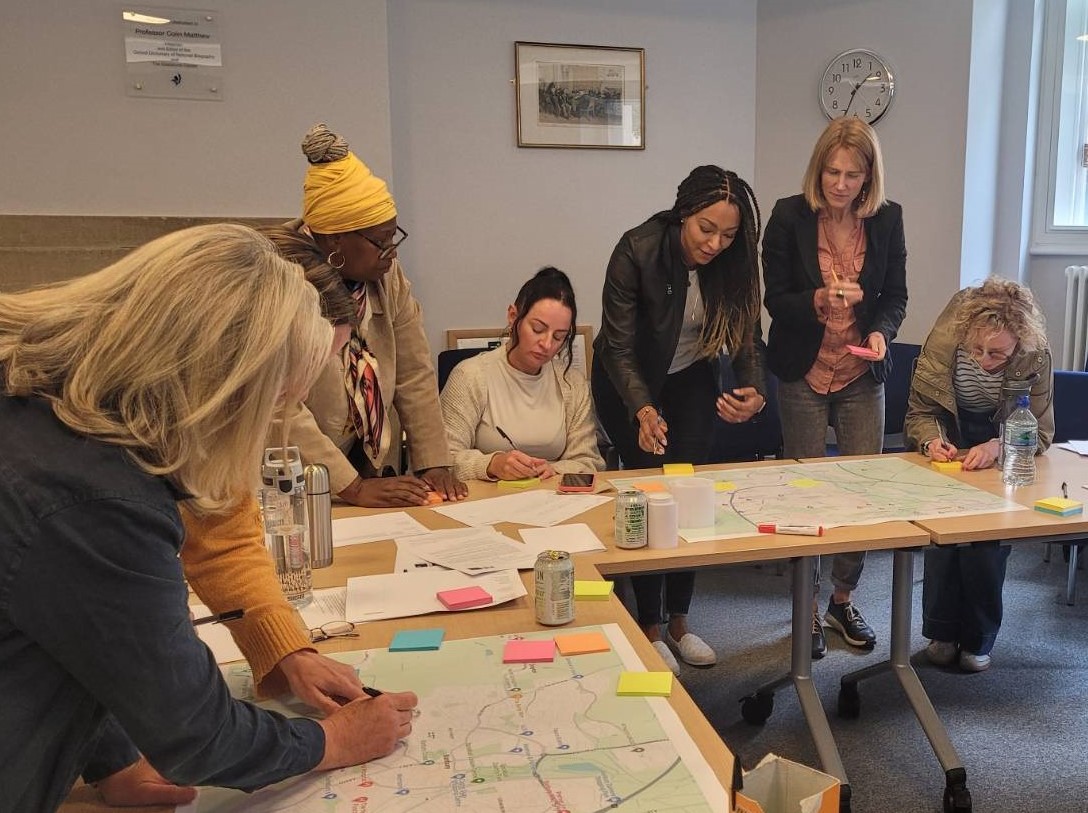
Community Public Health Workshop Mapping Exercise