

Burning Down the House
2021 - 26
An innovative collaboration between research and theatre
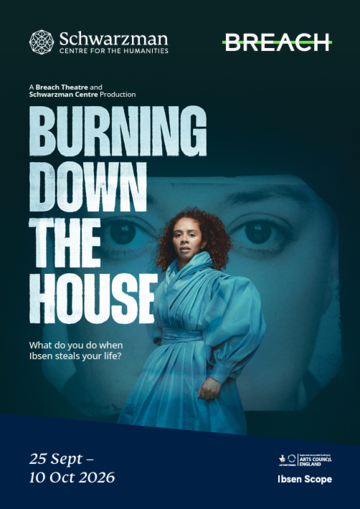
Burning Down The House premiered at the Schwarzman Centre for the Humanities, Oxford, in September 2026. It is a collaboration between Oxford researchers Professor Kirsten Shepherd and Tzen Sam, and Breach Theatre.
The project began in 2021 with a TORCH KE Fellowship grant, and culminated in a fully-mounted production five years later.
"Burning Down the House is the product of a collaboration that I initiated with Billy Barrett and Ellice Stevens of Breach Theatre company and with two other vital members of our group: Tzen Sam, Research Assistant and doctoral candidate in English here at Oxford, and Gaye Kynoch, a literary translator based in Copenhagen with a background in theatre and a particular [gv2] focus on Scandinavian literature. Billy and Ellice have been working with Tzen, Gaye, and me over the past 5 years to develop this show. It has been a fascinating process to turn research into theatre and we have learned so much about making theatre, something that academics studying theatre usually don’t get to do very often."
- Professor Kirsten Shepherd (English)
About the play
Who has the right to tell which stories? Where's the line between inspiration and exploitation? Does any of that matter, if the story's good?
Scandinavia, 1879. Playwright Henrik Ibsen scandalises audiences with A Doll's House, whose heroine Nora walks out on her family. But to one woman, the story is all too familiar. Laura Kieler, a young writer who had turned to Ibsen for help, finds that he has stolen her harrowing circumstances as the play's raw material. As Ibsen's literary fame ignites, Laura's life falls apart, and she must fight to save her reputation and her relationship with her family.
In Burning Down the House, Laura steps out of Nora's shadow and takes a theatrical flamethrower to Ibsen's version of events.
Burning Down the House revisits Henrik Ibsen's most renowned work, A Doll's House, shifting the focus onto Laura Kieler, the real woman, writer, and friend of Ibsen whose difficult personal circumstances he rewrote into the character of Nora without her knowledge. A writer herself, Kieler responded with her own play, Men of Honour, a bold indictment of Ibsen's appropriation of her private life. Burning Down the House asks urgent questions about the ethics of biography, the silencing of women, and who is allowed to tell another person's story. In doing so, Breach's new play provides a powerful corrective to the history of A Doll's House and brings to life a woman writer little known outside Scandinavia who – unwittingly – served as the model for one of the world's greatest feminist plays.
From Oxford research to a brand new play: The Story behind Burning Down the House
By Kirsten Shepherd
Burning Down the House is the product of a collaboration that I initiated with Billy Barrett and Ellice Stevens of Breach Theatre company and with two other vital members of our group: Tzen Sam, Research Assistant and doctoral candidate in English here at Oxford, and Gaye Kynoch, a literary translator based in Copenhagen with a background in theatre and a particular [gv2] focus on Scandinavian literature. Billy and Ellice have been working with Tzen, Gaye, and me over the past 5 years to develop this show. It has been a fascinating process to turn research into theatre and we have learned so much about making theatre, something that academics studying theatre usually don’t get to do very often.
Why I started this collaboration
I have been studying Ibsen’s plays since 1990, when I spent a year at the University of Oslo on a Fulbright Grant and had the chance to learn from some of the great Ibsen scholars of the time and to study the plays in the original language. It was full immersion, and I was hooked. I combined my background of growing up speaking Danish with my new academic interest in Ibsen and in Norwegian literature more broadly. It’s a handy combination for an Ibsen scholar, since Ibsen wrote in Dano-Norwegian, at a time when the Norwegian language was developing away from its Danish influence.
I didn’t hear about Laura Kieler at that time. It was the following year, when I started my studies at Oxford, that I began to see her name cropping up here and there in Ibsen studies—a footnote or a brief mention in passing when writers discussed A Doll’s House. For the next thirty years, I kept having that experience, and I was increasingly intrigued by the incongruity that so little was said about the woman whose life events had inspired one of the world’s best known and most produced plays. Who exactly was Laura Kieler? Why did we never hear about her? The fact that she was a prolific and successful writer in her own right was a major part of the intrigue for me, as I have spent much of my career researching neglected women writers. I wanted to know more.
Fast forward to 2021, when I attended a talk given by Billy Barrett and Ellice Stevens of Breach Theatre here at Oxford, as part of a TORCH-funded research network that I was co-convening called Reimagining Theatre and Performance. I was riveted by their talk with Professor Sos Eltis about making their show It’s True It’s True It’s True, about the Renaissance painter Artemisia Gentileschi and her brave fight for justice. I went up to Billy and Ellice afterwards, introduced myself, and told them about my idea of developing a show about Laura Kieler and the true story behind Ibsen’s A Doll’s House. Would they be interested in working with me? Thankfully, they said yes and that launched our 5-year collaboration culminating in this brilliant new play, Burning Down the House, now having its world premiere in our new Schwarzman Centre for the Humanities. It is the first original play to emerge directly from research in the Faculty of English and in the Humanities Division.
The research that underpins the collaboration
Our research on Laura Kieler has brought us into archives in Copenhagen and Oslo, looking at her unpublished letters and her ‘patient journal’ from her month in the asylum, which Tzen tracked down for us. Gaye has translated Kieler’s play, Men of Honour, into English and it is now published in the other major output of the project: an Oxford World’s Classics volume of three plays, Ibsen’s A Doll’s House, Kieler’s Men of Honour, and Ibsen’s When We Dead Awaken, that was published by OUP in November 2025. I co-edited this volume with Tzen, who is finishing her doctoral work on Ibsen’s first female translators in Britain, and Gaye provided the translations. Gaye is an expert translator of Scandinavian literature, most recently a 3-volume edition of works by Ludvig Holberg, the great 18th-century Dano-Norwegian playwright and one of Ibsen’s main influences. Working with these two women has been an extraordinary privilege.
The book we published together contains our Laura Kieler research. In the book’s introduction you can read the fascinating story of Laura and Henrik’s interactions and understand in fuller detail the background to the play Burning Down the House. We also touch upon some of the ways in which Ibsen changed Kieler’s story when he fashioned his own play from it, and how his seemingly small changes made a dramatic difference. For example, Ibsen made Nora a housewife rather than a woman writer; she was thus an ‘Everywoman’ figure, representing all women—mothers, sisters, wives, aunts, daughters. Her behaviour couldn’t be dismissed or explained away as specific to her profession, women writers being often caricatured and dismissed as ‘cranky’ and erratic in the period. He amplified Nora’s culpability by having her commit the crime of forgery (even worse, forging the signature of her newly deceased father), which Laura had not done. He made Nora seem lightweight, vain, deceptive, and flirty. And, most damagingly—yet a master stroke on Ibsen’s part—he had Nora leave her husband and children at the end of the play (though not with a ‘slam’ of the door, as is often mistakenly alleged, but with just the sound of the front gate clicking into place as she leaves—because she does not leave in anger, but with calm resolution).
These changes show Ibsen’s instincts as a playwright and ensured A Doll’s House’s success, but they were deeply detrimental to Kieler. For the rest of her life, she tried to get Ibsen to state publicly that the character had nothing to do with her (he refused), and wrote articles explaining that ‘I am not Nora.’ Reading these articles, and seeing the efforts Kieler made to set the record straight, impressed on us how profoundly the Ibsen-Kieler narrative is about agency: Kieler trying to wrest some kind of control, rather than just having things happen to her. Researching her also reinforced the depth of her influence on Ibsen's thinking about women and about theatre; Ibsen’s Notes to the Modern Tragedy demonstrate this most strongly.
The autonomy of theatre
Yet, a play is not merely a vessel for facts. As with all works of art that emerge from true stories, Burning Down the House is its own creative entity. It is at once indebted to our research yet entirely free to depart from it and take any artistic license it chooses. The test of the play is not how closely it adheres to our research but how well it works as a piece of theatre.
In my other main area of research, I work on the relationship between theatre and science, and one of the recurring tensions in discussions about plays that engage with scientific ideas is: how accurate is the science in the play? Should a ‘science play’ first and foremost educate? What is a play’s obligation to the scientific facts it is dealing with? These questions have often dominated debates about science and theatre because of what’s at stake: for Michael Frayn’s Copenhagen, for example, the pressing questions it raised about responsibility for the development of atomic weapons. The play generated tremendous interest in how close to the ‘truth’ it got in its representation of history. The debates were fascinating, with scientists and artists poring over the facts and testing the play against them, yet sometimes this focus threatened to overshadow the play’s status as a piece of theatre, a creative work. It will be interesting to see what audiences and critics make of Burning Down the House in relation to perceived ‘truths’ about the historical and literary material with which it engages.
This is where the magic of performance – and especially of Breach’s unique approach to theatre and storytelling – comes in. What entranced me back in 2021 when I heard them speak and saw their work, and when I went to their acclaimed 2025 play After the Act at the Royal Court in 2025, was their inventiveness and playfulness with true stories — how they brought real people from long ago to life through their combination of verbatim dialogue, innovative visual techniques, powerful imagery, incisive writing, and vibrant music, all the while keeping a firm hold on the foundational facts of the stories and prompting serious reflections about the material. Their work is a wonderful mixture of real-life sources and artistic freedom that sparks discussion and debate. Burning Down the House will, I’m sure, showcase Breach’s trademark style of forceful, illuminating engagement with history and some of its untold stories.
There might not be as high stakes in the Ibsen-Kieler story as in the history of German and Allied bomb projects during World War II, but nonetheless, this imaginative encounter with the truth matters deeply. One woman’s traumatic experiences generated the world’s most iconic feminist play, a drama that is read and produced globally and that has changed lives, often in places where women are still denied equal rights to men. A Doll’s House has to date been performed in 99 countries across the world (see the Ibsen Performance database, an extraordinary resource on where and when Ibsen’s plays have been produced around the world). Burning Down the House helps us confront issues at the forefront of our contemporary lives right now, such as consent and appropriation, the #MeToo movement, listening to women and their stories, and valuing their experiences.
Serendipity
The word that best describes this whole Ibsen-Kieler project, including the co-edited Ibsen-Kieler volume and the collaboration with Breach on Burning Down the House, is ‘serendipity’—the unexpected and happy alignment of shared interests and complementary capabilities. Serendipity launched our project right from my first approach to Breach after the seminar in 2021; it brought Tzen into the collaboration as Research Assistant, a position that she was extraordinarily well equipped to fill and that yielded exceptionally important material such as Laura Kieler’s ‘patient journal’ from her time in the asylum in Copenhagen; and serendipity gave us Gaye, whose translations of Ibsen and Kieler sparkle and leap off the page, refreshing Ibsen for new audiences and introducing Kieler for the first time to the English-speaking world. Serendipity cropped up again in 2023 when Breach were approached out of the blue by the Liverpool Institute for the Performing Arts asking if they had any material they were working on that they’d be willing to use for teaching a group of acting and design students for their final performance projects. Our Liverpool interlude was a brilliant experience as we got to see Breach at work up close over a sustained period, managing to devise a show with 35 acting students (featuring 4 Noras and Lauras!) and seeing how they work with raw research materials in real time. Serendipity all the way—but it takes agility and readiness to seize such opportunities as Breach did. As the Swedish director Ingmar Bergman reputedly said, 'only those who are well prepared are free to improvise.’
Money matters
The project could not have happened without financial support, and this came from TORCH in the form of a TORCH KE Innovation Seed Fund grant and then a TORCH Knowledge Exchange Fellowship that I held in 2022-23. Breach then got a prestigious Ibsen Scope award, its first international funding and a major boost to the devising process of the show, followed by Arts Council funding to finish developing it. The Humanities Cultural Programme has provided exceptional support as well in enabling the show to be premiered here.