

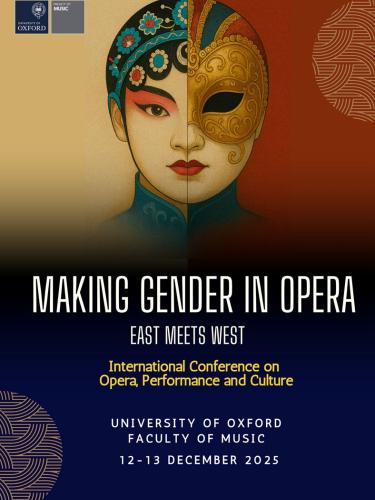
Making Gender in Opera: East Meets West
An international conference bringing scholarship on gender study and performance practice into dialogue
On 12–13 December 2025, the conference Making Gender in Opera: East Meets West brought together scholars and practitioners in the Schwarzman Centre for the Humanities for two days of interdisciplinary exchange on opera and gender. Led by Professor Suzanne Aspden and co-organised by DPhil candidate Zhaoyi (Bette) Yan (Performance Research Hub Co-ordinator), the conference explored how gender is embodied and understood across operatic traditions in different cultural contexts. By bringing scholarly discussion into dialogue with live performance practice, the conference also explored how performance itself can contribute to research into gender and identity.
The conference gathered an international and interdisciplinary group of contributors. Participants included Professor Ashley Thorpe (Royal Holloway, University of London), Dr Haili Ma (University of Leeds), and Josette Bushell-Mingo OBE (Royal Central School of Speech and Drama), alongside scholars from Cambridge, London, Manchester and other centres across the United Kingdom, as well as international contributors from Europe and North America. Bringing together researchers working across musicology, theatre studies, gender studies, cultural theory and performance practice, the event also attracted audiences from across Oxford and beyond, extending its reach into wider cultural communities.
Across the two days, discussions ranged from Chinese all-female Yue opera to Puccini’s La Bohème, from German-speaking reinterpretations of Turandot to Japanese and English-language Nō, and from Lithuanian contemporary opera to the politics of the liminal voice across musical traditions. Papers and roundtables engaged with music analysis, theatre semiotics, gender studies, visual culture, embodiment and translation studies. Rather than treating ‘East’ and ‘West’ as fixed categories, the conference created a space in which different operatic systems could be placed into meaningful dialogue around questions of gender and performed identity.
One of the highlights of the conference was its integration of research with live practice. This was most powerfully realised in a performance-demonstration featuring visiting Peking opera artist Ms Jin Zhao, with jinghu player Mr Wenxue Gao. The session was structured and facilitated by Bette Yan, whose research on cross-gender performance in Chinese opera shaped its intellectual and practical framework. Specialising in male roles, Ms Zhao offered a rare, step-by-step insight into the backstage processes of Peking opera, demonstrating how a woman is made a man on the Chinese opera stage through make-up, costume, headgear, gesture and musical structure. Yan’s live interpretation and contextual framing enabled these practices to be understood in relation to the broader themes of the conference.
Through this combination of live demonstration and scholarly discussion, participants were able to see how gender in Chinese opera is constructed through codified aesthetic systems and disciplined bodily practice. By bringing backstage preparation into a research setting, the demonstration made visible aspects of performance that are often difficult to convey through conventional academic presentations. For many attendees, it was their first close encounter with Peking opera as both preparation and performance. The session was met with enthusiastic engagement, prompting questions and lively exchanges between artists and audience members.
The discussion that followed further extended this dialogue. Josette Bushell-Mingo OBE, Principal of the Royal Central School of Speech and Drama, offered an insightful response, connecting Peking opera embodiment to broader questions of theatrical language, gesture and sign-based communication. Drawing on her experience in performance, musical theatre and long-standing work with sign language communities, she reflected on how meaning can be conveyed beyond spoken language through the body, opening up a striking cross-cultural dialogue between performance practices. She also expressed strong support for continuing this model of exchange, encouraging future collaborations between researchers and practitioners and advocating for the return of such events.
By bringing together different operatic traditions and research approaches, Making Gender in Opera demonstrated the potential of opera studies to move beyond disciplinary and cultural boundaries. The conference illustrated the value of bringing artistic practice into dialogue with academic research, opening up further possibilities for collaborative and practice-led approaches to performance studies. Its exchanges also reflected the wider aims of the Performance Research Hub: connecting researchers and practitioners across disciplines and creating opportunities for continued dialogue and future collaboration.